The Prime Number Search book series by Francis Gurtowski
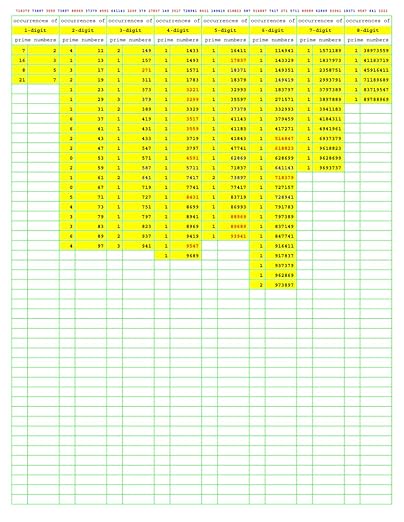
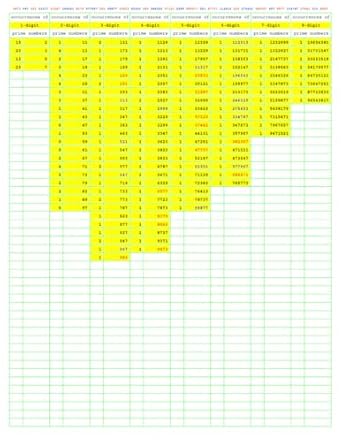
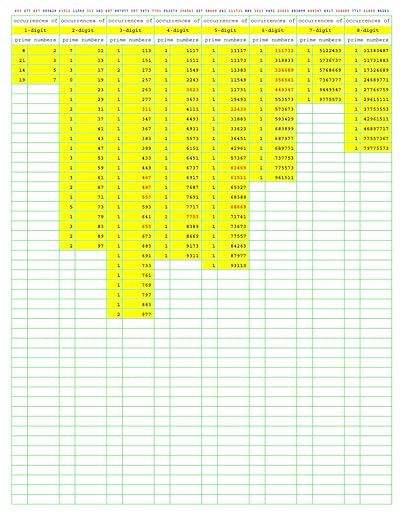
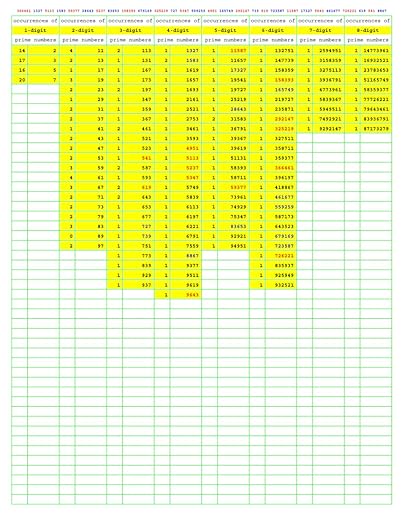
The 294 puzzles found in each volume are mathematical recreations intended for practically all age groups.
|
|
|
|||
|
|
|
|||
|
|
|
|||
|
|||||
|
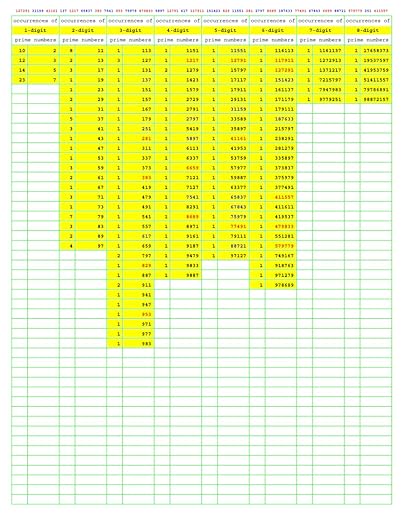
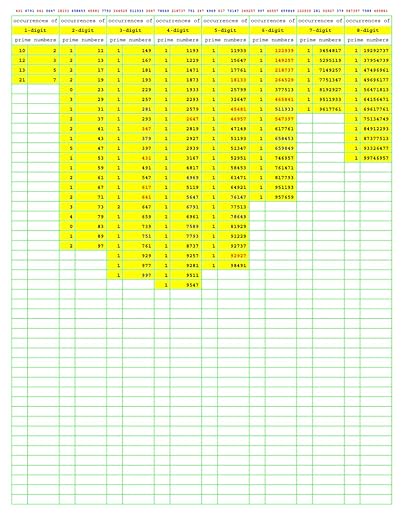
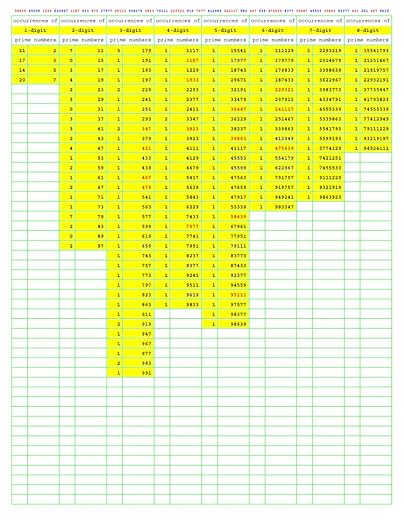
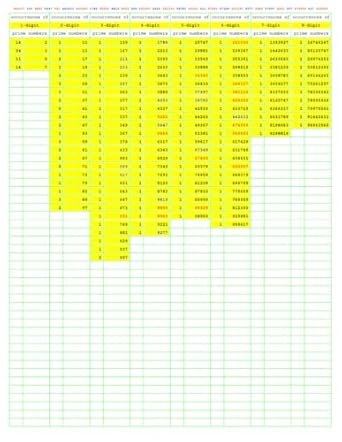
The 294 two-page puzzles found in each volume of the Prime Number Search book series are mathematical recreations intended for practically all age groups; please do not be put off by the mere mention of "prime" numbers.
Four of the supposedly "scary" prime numbers (2, 3, 5, and 7) are single-digit, and you will no doubt progressively develop an instinctive familiarity with longer and longer prime numbers as you grow into these puzzles. You can even appraise your tangible progress by (a) logging your results puzzle by puzzle and (b) making multiple passes through the very same set of puzzles in each volume. I invite you to cycle back, again and again, before moving on to another volume in this series. Each puzzle consists of a methodical permutation of a random combination of 132 Arabic numerals from 1 to 9 arranged horizontally in a single row and read left-to-right big-endian (BE) style. That is, each puzzle is a so-called Gurtowski Concatenation of so-called Gurtowski Numbers as described below. The objective is to find and enumerate as many as you can of the many, many decimal prime-numbers that are overlapped there. |
A word or two about my methodology: in constructing these puzzles I exclusively use numbers that are "primer than prime" which I flatter myself to designate with the label the Gurtowski Numbers.
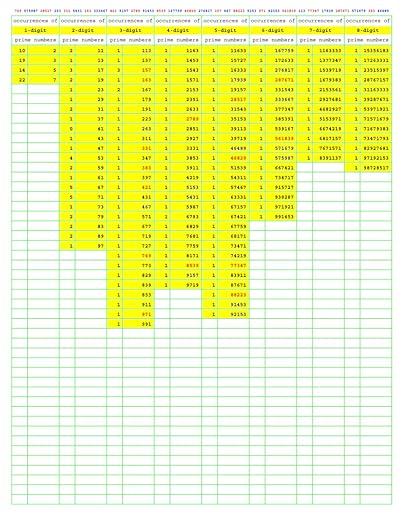
The Gurtowski Numbers simultaneously satisfy the following three criteria. Firstly, each Gurtowski Number is a decimal number; but not every decimal number is a Gurtowski Number. Secondly, each Gurtowski Number is a prime number; but not every prime number is a Gurtowski Number. Thirdly, each Gurtowski Number is expressed with 3-6 of the nine Arabic numerals 1-9, explicitly excluding the symbol 0. The 52,288 Gurtowski Numbers range from a low of 113 to a high of 999,983. The first twenty-five prime numbers (2, 3, 5, 7, 11, 13, 17, 19, 23, 29, 31, 37, 41, 43, 47, 53, 59, 61, 67, 71, 73, 79, 83, 89, and 97) are not Gurtowski Numbers because they are too short in length. The remaining (innumerable) (Arabic-numerals only) prime numbers beyond 999,983 (1,111,157, 1,111,169, 1,111,181, and so on) are not Gurtowski Numbers because they are too long in length. |
The point of all this is that I limit myself to the use of the Gurtowski Numbers when constructing another of my concoctions: the Gurtowski Concatenations of Gurtowski Numbers.
Each Gurtowski Concatenation is 132 Arabic numerals in length, such as 5527, 79699, 95339, 717133, 6379, 417731, 682739, 823, 78317, 163, 131, 681341, 75869, 675797, 66343, 56467, 75167, 5233, 29917, 881, 485593, 15959, 8893, 46499, 95569, 44621, 271, and 92893. That specimen's 28 concatenates are respectively 4, 5, 5, 6, 4, 6, 6, 3, 5, 3, 3, 6, 5, 6, 5, 5, 5, 4, 5, 3, 6, 5, 4, 5, 5, 5, 3, and 5 Arabic numerals in length. In other numbers, that specimen consists of five of length three and four of length four and thirteen of length five and six of length six. Do the math: 5 x 3 numerals + 4 x 4 numerals + 13 x 5 numerals + 6 x 6 numerals = 15 + 16 + 65 + 36 numerals = 132 numerals. At one extreme, a Gurtowski Concatenation can theoretically consist of precisely forty-four three-numeral Gurtowski Numbers. At the other extreme, a Gurtowski Concatenation can theoretically consist of precisely twenty-two six-numeral Gurtowski Numbers. Do the math: 44 x 3 numerals = 22 x 6 numerals = 132 numerals. |